Core Services





Published: 06/01/26
Cyber Security Trends 2026: Our Experts’ Predictions

Looking Ahead to the Cyber Security Trends of 2026
As we enter 2026 one thing is clear, the conversation around cyber security isn’t slowing down, it’s accelerating.
Looking back at our 2025 predictions, we anticipated that AI would become a double-edged sword and that “Identity” would become the new endpoint. We spent the last year helping organisations move from a “trust but verify” mindset to active defense against data leakage and social engineering. While those themes remain foundational, the reality for the year ahead is even more layered.
Technology will continue to evolve, but so will the risks, the controls, and the human factors that shape how we respond. Our partners have shared thoughtful predictions for 2026, and while AI still dominates the headlines, the focus is shifting from general usage to specific, autonomous action.
At SEP2, we see predictions as more than forecasts; they are an opportunity to start meaningful conversations. Which trends will truly reshape the threat landscape? Where should security leaders focus their attention? How do we maintain trust in a world where even authenticity is being questioned?
Here are the trends our experts believe will have the biggest impact in 2026.
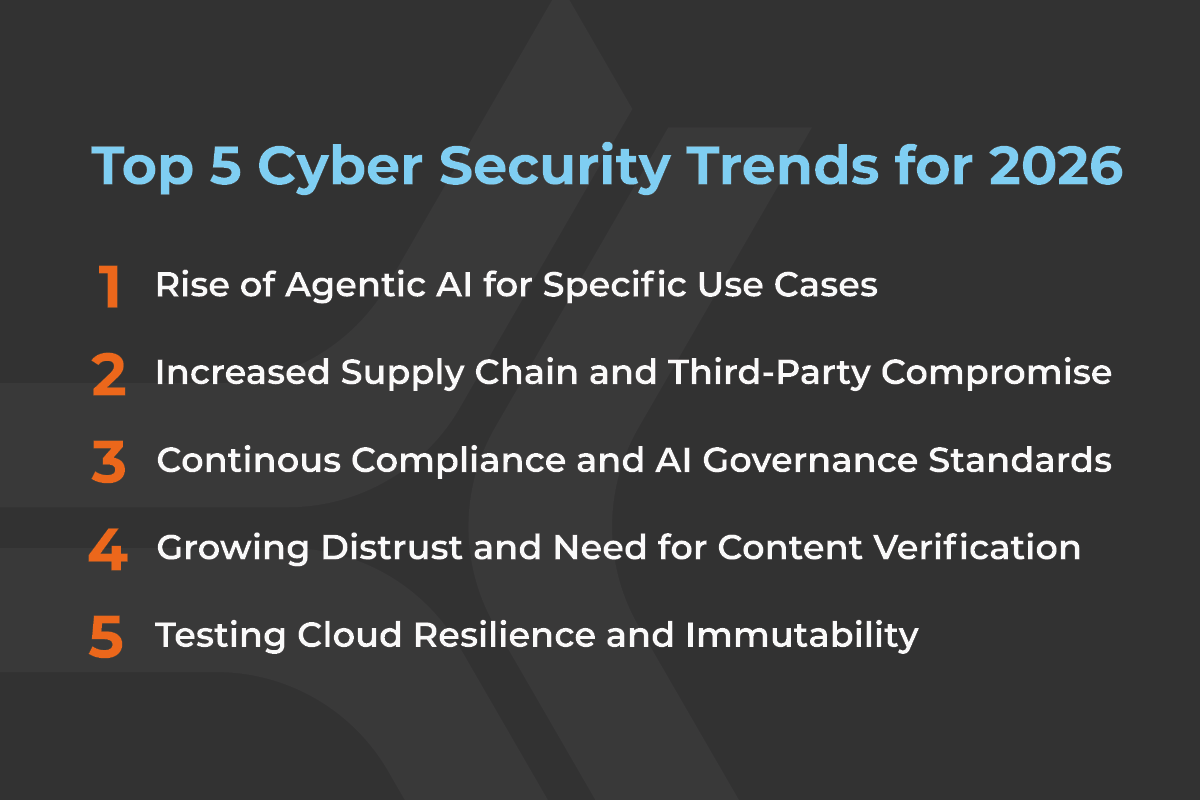
Top 5 Cyber Security Trends for 2026
What Actually Matters in 2026?
Predictions from our partners set the stage, but what does our own team see on the horizon? We asked SEP2’s technical experts to share the trends they believe will matter most in 2026. Their perspectives go beyond headlines, focusing on practical challenges and opportunities that security leaders will face in the year ahead.
Google: Scaling Defense with Specialised AI
James Woodward, Head of Technology
Which of our partners’ predictions resonates with you the most?
I believe Google’s predictions align with my expectations of what 2026 has in store for us.
What additional trends do you foresee for 2026?
We’ve seen widespread increase of AI everywhere in 2025, but I believe that mass adoption still isn’t where a lot of predictions thought it would be. The increased use of LLM-based AIs has shown that general usage human language AI models can only be useful in limited situations.
In 2026, I think we will see more of a rise of agentic AIs tailored and trained for specific use cases, on both the defensive and attacker sides of the coin. What threats can AI models pose that are specifically trained on IoT or OT networks? An AI model specifically trained to read firewall logs should surely give better results than expecting a general LLM to do the same task.
Smaller, highly specific AI models that are part of a larger agentic attack vector will be able to be more mobile and run on more restrictive hardware, meaning greater availability to attackers and defenders. Perhaps we may see malware distributed AI models replace Cryptominers as a new method of distributed AI attacks?
Any other comments or insights?
We’re already seeing a rise of general distrust across the internet, where questioning if anything is AI-generated is becoming commonplace (I even heard this from my 60+ year old parents over Christmas). Increasingly we’re going to need the ability to confirm that content and communication is sourced from a human. Maybe the return to older technologies such as personal certificates and signing all our communications with keys needs to make a return? Verification of who, or what, you are talking to is going to be a big part of 2026.
Wiz: Resilience in a Cloud-First World
Jon Cumiskey, Head of Information Security
Which of our partners’ predictions resonates with you the most?
Wiz’s predictions are talking most directly to many of the real world challenges that security leadership are facing.
What additional trends do you foresee for 2026?
Ultimately, the abuse of supply chain/third party compromise is proving to be fertile ground for attackers – and further targeting of suppliers of software and services is going to continue to reap benefit for threat actors. On the subject of the most disruptive threats, while traditional ransomware is still very prevalent, I also believe that we will also continue to see actors testing the boundaries of the immutability and resilience of organisation’s cloud deployments.
Any other comments or insights?
Much commentary, thoughtpieces and conversation is occurring around AI. Although there is much validity to this, I see a new risk emerging, which is that conversation surrounding technical AI risk shuts down and drowns out conversation on other risks. Also, in reality many of the risks being talked about AI could apply to any other previously deployed technology – AI is a technology that should be risk assessed and have appropriate controls put in place. Prompt injection is a new flavour of input sanitisation, which has been a security conversation since the dawn of time. Obviously, it requires a different control paradigm to manage it, but it’s not necessarily a new risk.
The biggest risks surrounding AI I see are much wider – relating to the breakdown of trust in digital content (amusingly, perhaps Blockchain still has a role to play here…), and the potential for wider societal disruption caused by unemployment driven by AI adoption in enterprise. These are more important and more complex problems that will need to be addressed by business leaders and government, not just security leaders.
To perhaps highlight my previous point surrounding AI dominating risk conversations currently, I have accidentally proven this point myself in what I have written.
Check Point: The New Era of AI Governance and Compliance
Johan van Rooyen, Principal Security Consultant
Which of our partners’ predictions resonates with you the most?
The 2026 predictions from Check Point regarding AI governance, risk, and compliance particularly resonate with me. As AI moves from experimentation to integration, the focus must shift toward how we govern these tools responsibly.
What additional trends do you foresee for 2026?
The fallout from high-profile supply chain compromises will elevate information security to a primary Board-level concern. We will see security move out of the IT silo and into the realm of strategic risk management.
Furthermore, I expect AI standards like ISO 42001 and the NIST AI RMF to become the new “cost of doing business.” Much like ISO 27001 or SOC2, these won’t just be about regulatory compliance – they will be driven by customer demand and the need to prove digital integrity. Finally, we will see the end of “point-in-time” compliance; certifications will become a continuous part of the organisational fabric rather than an annual exercise.
Any other comments or insights?
We must revisit the “Golden Triangle” of People, Process, and Technology to move past the idea that humans are simply the “weakest link.”
- People: Move beyond passive training. Implement multi-channel awareness programs and establish clear metrics to measure behavioural change and risk reduction.
- Process: Build robust business processes that support, rather than hinder, staff. For instance, dual-authorisation in Finance is a strategic investment in loss prevention, not just an administrative hurdle.
- Technology: Ensure the “brilliant basics” are in place. Advanced email security and universal MFA adoption remain some of the most critical technical defenses in the arsenal.
Preparing for the 2026 Landscape
2026 won’t be defined by a single technology or threat, it will be shaped by how we respond to complexity. AI will play a role, but so will governance, supply chain resilience, and the human factors that underpin every decision.
Predictions are valuable, but preparation is what turns insight into action.
The real challenge is whether we’re ready to adapt, to verify trust in a digital-first world, and to keep security aligned with business strategy. At SEP2, we believe that starts with collaboration, clarity, and a commitment to doing the basics brilliantly while planning for what’s next.
Partner Sources
The 2026 Tech Tsunami: AI, Quantum, and Web 4.0 Collide by Check Point
Cybersecurity Forecast 2026 by Google Cloud Security

Follow Paul Starr on LinkedIn for more insights on cyber security and company updates
Share this Post: